Showing posts with label Photos. Show all posts

Monday, 16 November 2015

All White on the Night

In the course of writing this blog I may have mentioned, once or twice, my love of natural history. I've studied it, I worked with it, and my hobbies are largely based around it. During the course of my studies I've learned more about the eminent men and women who have advanced our understanding of nature in the UK and abroad - academics, scientists, explorers, and the many, many people working in conservation around the globe today. If I told you to name the most influential, who would you go for? David Attenborough? Charles Darwin? How about Gilbert White? Did anyone mention Gilbert White?! Ten gold stars if you did.

Gilbert White is broadly acknowledged to be the UK's first natural historian, discussing ideas like migration and species identification before Darwin was even born. White made observations of the natural world around him, writing his thoughts down and corresponding with others on his musings (the equivalent of a blog!). These letters were published as 'The Natural History of Selborne', detailing his findings in his home village of Selborne in Hampshire (and available free on kindle for anyone bold enough to tackle it!). Selborne still stands, as does the vicarage that White lived in - now converted to a museum in his honour (and, incidentally, also a museum in honour of Captain Lawrence Oates, one of those who made the fateful journey to the South Pole with Scott).
 
White's original manuscript
And so it was to Selborne that I went for a couple of days break, in order to see the place where the great man lived and walked. At his house, his vegetable gardens are still in place and the library is stocked with hundreds of versions of his book from around the world, including the original manuscript. It was pleasing to imagine White sat at his desk, with views out over his gardens into the woods beyond, pondering such questions as whether swallows migrate or spend the winter hibernating in the mud at the bottom of ponds. Whilst that may seem obvious today, global travel had not yet opened up the possibility of finding our migrants in other countries, and there certainly wasn't any sophisticated tracking technology available.

The house and vegetable garden
The village is nestled at the base of Selborne Hill, up which Gilbert and his brother constructed a zig-zag footpath to the top, giving fantastic views of his house and the surrounding area. The autumn colours made the uphill slog well worth it. As I strolled around his gardens a peregrine falcon drifted overhead and circled against white clouds before a few powerful flaps of its wings propelled it from sight. What would Gilbert have thought of the bird? Did he know that this is the world's fastest animal, capable of speeds of 200mph? I doubt it!

The view over Selborne
The fact that we know so much about the world around us today is by no means attributable to Gilbert White, but he was the first observer of ecology to publish his observations in a way that allowed others to examine them further, and from such work comes greater scientific understanding. And for that we should be grateful to Gilbert and a small band of amateur natural history enthusiasts.

Autumnal apple and ladybird in the gardens

Sunday, 18 October 2015

Count me in!

I’ve been told that there are only three types of people in this world: those that can count, and those that can’t. For those that can’t, the numbers game can be something of mystery, or even a painful experience. But for those that can (and those that can’t!), numbers form the basis of most of the measurements by which we judge our lives. They represent targets, achievements and goals, they provide a benchmark against which we strive to improve or compete, and mark the passing of time to give context to those achievements.

So it is in conservation and birding. We count birds; whether to determine population trends over time or simply for competition with others or ourselves. We count numbers of individuals, breeding pairs, numbers of species, fledged young, and we do this repeatedly to assess the health or otherwise of a particular habitat or location, and then to see what happens in that place over time.
One particular place where this has been happening lately is the Isles of Scilly. The archipelago is a group of over 100 islands (depending on the tide) located 28 miles off the tip of Cornwall, with a permanent population of around 2,200 people. For the last nine years I have been privileged enough to visit the islands each autumn to lead guided walks for the RSPB on Tresco, one of the five inhabited islands. The purpose of the visit is to raise awareness of the work the RSPB are doing on the islands for wildlife, and success is largely judged on numbers: how many people we meet, how many walks we do, how much money we raise, how many members we make. But these numbers don’t tell the whole story here. Other numbers have started to become more important.

Storm clouds off Bryher
Back in 2013, a partnership project involving five different organisations began, with the aim of improving the productivity of breeding seabirds around the islands. About 20,000 individuals from 14 different species of seabird come to the Isles of Scilly to breed each year, but populations of most of them have been doing badly due to predation of eggs and chicks by rats. The Isles of Scilly Seabird Recovery Project aims to remove rats from St Agnes and Gugh, two of the most important seabird nesting areas, and started doing so in autumn 2013. The 84 inhabitants of the islands all signed letters of support for the proposal, and baiting began. Over just six weeks all signs of rats disappeared, and no rats have been seen since!
A survey tunnel
The knock on impact of this work was seen in 2014, when surveys revealed manx shearwater chicks on St Agnes and Gugh surviving to fledging – 10 of them in fact. And in 2015 there were 28 of them. This may seem like small fry, but this is where numbers come in. Not a single manx shearwater chick had been recorded by anyone on those islands in living memory. None. That’s zero productivity over perhaps 100 years. And now there are at least 28 chicks leaving the islands for a life at sea. Even better, storm petrel chicks have been confirmed in 2015 – the first for many years.
A Manx Shearwater chick
Conservation projects are rarely so successful so quickly, and we can only assess how well they are performing using data – without a baseline we would have nothing to compare to, and without rigorous, consistent survey techniques we would not be able to draw reliable conclusions. The Isles of Scilly Seabird Recovery Project is a fantastic example of what can be achieved through partnership working and community support, and of course an excellent example of how numbers have shown that success. Let’s just hope the surveyors were not among the five out of every four people who have problems with fractions.

Saturday, 4 July 2015

The Perfect Storm

Did anyone else thoroughly enjoy the storms overnight last night? Not only did they bring welcome relief from the stifling heat, and even brief respite from the worst affects of hay fever, but it was one of the most spectacular storms I can recall. I'm sure in my youth I saw some pretty spectacular storms, but I genuinely can't remember the last time I saw such astonishing forked lightning.

I think I was about seven or eight, and I was staying with my grandparents in Torquay. Waking up in the night to the rumbles of thunder, my sister and I crept downstairs to the living room, where there were two comfortable recliners sitting in a giant wall length window at one end of the room. We turned the seats to face outwards, and were treated to half an hour of horizontal forked lightning that spread from one side of the window to the other like a giant widescreen light display. The fork would actually spread over several seconds, snaking and splitting its way in every direction like the boughs of a tree in winter. I don't think I've ever seen anything like it before or since.

So last night I had just gone to bed when I noticed flickering lights in the bathroom. Fearing a suspect bulb or an alien invasion I went to investigate. Realising they were coming from outside, I opened the window to see what crazy Friday night activity was lighting up the sky. The flashes were so frequent that I assumed they had to be created by man in some way. But the sky illuminated in the same way as lightning, and soon the thunder started to rumble ominously in the distance. Very quickly the fork lightning started, and I realised it was heading my way.

I've always wanted to try to photograph a storm like this, so I tried to think through all the equipment I would need and where it was. With all the lights off to enjoy the storm at it's best, dressed in just my boxer shorts and in a sleepy frame of mind, the next five minutes was an awkward series of bumping into walls, stubbing toes and expletives as I searched the house. I grabbed my camera and two lenses, a tripod and a head torch and made my way back to the bathroom.

Standing in the bath with the window open fully I had the full expanse of sky at my disposal. Electing to use a wide angle to maximise my chances of capturing something, I found the longest exposure I could and fired. From this I could gain an idea of where the houses and the focus were, and adjust each shot accordingly. The first few shots actually turned out to be the best.


After a few minutes the cloud and rain came in and obscured the best of the lightning. At this point the whole sky was lit up with each flash and exposure became an issue as it was impossible to judge how much light would actually reach the sensor over the 15-30 second shutter release.


As the storm intensified the rain became too much and was starting to come in through the window, so I relocated to the bedroom on the other side of the house and watched the monsoon pass. Great torrents of water were flowing down the road and pavement too, so that each passing car was spraying a wave onto the roadside. The storm continued overhead, and protected from the prevailing wind I was able to get some more photos from the front window. This time the challenge was the street lights, which overexposed the houses opposite but failed to capture the best of the light in the sky. It did throw up some interesting light trails from the passing cars, and at one point a fire engine went through the shot.


Overall the shots were not as spectacular as the storm itself, but they were never likely to be and as a first attempt I'm not too disappointed. What a fantastic display of pyrotechnics. The storm took over an hour to pass entirely, and from what I hear continued north exciting a similar response from people across the country.

Monday, 2 February 2015

Bird Cruising

There are many times in life when I wish I was in any way cool or trendy. But I am in fact a geek, and rarely does it hit home as much as when I go bird cruising. When people ask me how I'm spending my weekend, the reply 'bird cruising' leaves many people dumbfounded. It shouldn't do, as it is pretty much exactly as it sounds, but folks who don't know about my passion for birds assume it means something completely different, give me a knowing nod, and wish me luck. This weekend I went bird cruising in Plymouth.

The stunning Tamar Bridge backdrop to the river
An ex-colleague and good friend of mine, Bruce, runs a series of boat trips up the River Tamar each winter, with his better half Chris. When I lived in Cornwall, my job was to wear something with an RSPB logo on it, wave at the crowd when I was introduced, and then freeze my extremities off for three hours whilst we travelled up and down the river. In theory I should be spotting birds to help Bruce with his commentary, but with so many avid spotters on board this rarely happens. Or if I do see something, I ask someone more qualified than me to determine it's identity. In practice my role is really to furnish Chris with the latest gossip to keep her entertained, and to ask Bruce unfairly complex bird-related questions to make sure he is on the ball (he never could pronounce the Latin name for Oystercatcher - a hilarious joke amongst us bird geeks!).

The Oystercatcher - Haematopus ostralegus
As a visitor returning for a one-time only tour of duty, I was delighted to find out that the early forecasts of snow and strong winds turned out to be relatively inaccurate, with stunning clear skies overhead. However, the plunging temperatures did necessitate a lengthy discussion about how many layers would be needed, and no matter how many were taken they were still not enough. The river is obviously quite an exposed place to be, and the boat lacks obvious opportunities for warming up through any form of rigorous exercise on board.

The River Tamar on a slightly warmer and calmer day!
The boat we usually use was in dry dock for repairs, and the replacement lacked the same capacity. This could have been beneficial if we had adopted the survival strategy of emperor penguins, rotating to the sides periodically to have our turn on the cold edge. Sadly this does not lend itself to suitable bird watching conditions, as people tend to want to see the birds that are spotted, which means a clear line of sight for binoculars to be pointed through. The new boat also had different technical arrangements to the old one, which meant the first ten minutes was spent fiddling with microphones in an attempt to make Bruce audible. First there was feedback, then there was nothing, then the volume was too low and finally the sound would inexplicably cut out part way through a sentence. It was like listening to an Eminem song on the radio with the explicit lyrics blanked out. This had a pretty disastrous effect, as sentences would end just as they got interesting: 'the bird on the left is a...' or 'curlews will mostly be eating...'. Hardly a cliff-hanger ending, I admit, but inconvenient nonetheless. The problem was eventually resolved with the use of a cable, which restricted Bruce's movements to a small area of the top deck like a bulldog on a chain. 

Leading ornithologist and part-time Madonna impersonator, Bruce Taggart
Once this was resolved we hit a steady stream of birds and associated commentary. We saw curlews attended by crows, learnt the difference between stabber and snipper oystercatcher foraging techniques, and were accompanied for at least half an hour by our own personal common gull (which is, incidentally, the least common type of gull in the area). A rare duck had been spotted in the area lately, and we had to double check every duck that we passed to be certain not to miss out. The main highlights of the cruise are the avocets and spoonbills.

The surprisingly uncommon Common Gull
Avocets are the beautiful and elegant black and white waders with an upturned bill that feature on the RSPB logo. The fact that avocets returned to breed in the UK is largely thanks to Hitler. To counter the threat of invasion from German forces on our Eastern seaboard, vulnerable areas of low lying coastal land were flooded. The resulting habitat, along with little disturbance during the war years, provided ideal conditions for the birds. Although they don't breed in the south-west, our rivers and estuaries provide suitably mild winter feeding grounds for them, and there can be a couple of hundred found around the Tamar Estuary each winter, usually in several flocks. After an hour or so heading up the Tamar, we still hadn't found any avocets in the areas we usually see them, and were starting to get concerned when an eagle-eyed spotter, another RSPB colleague Stuart, located about 200 in a flock at the river's edge. Conveniently by this point in the river the edge was very close to the boat as the channel narrowed, and we had fantastic views of the flock moving along the edge and also circling around the boat and landing back on the mud.

Avocet flypast
The spoonbills are usually found on the River Lynher, a tributary of the Tamar which we also navigate our way up. Spoonbills are imaginatively named birds, having as they do a spoon shaped bill. They have only recently started breeding in the UK, and relatively few birds are found in the country - the Lynher is one of the best places to see them. They are the size of herons, and bright white, so it would be easy to assume that this makes them stand out. Sadly not. When feeding along the shore they blend neatly into the reflective water and mud surface. We often encounter them roosting on rat island at the mouth of the Tamar. As we approached the island, the gathered band of spotters (what is the collective noun for a group of birdwatchers; a flock? A geekdom? A twitch?!) started poking their eyes onto telescopes and jostling for position in an attempt to be the first to locate a spoonbill. But none were to be seen on the island. Fearing failure (and these trips never fail to turn up a spoonbill!) we started up river, only to hear the call that the birds had cunningly tucked themselves onto the back of the island, on the shallow side where the boat could not go. They had also tucked their spoons (at least the size of a wooden spoon) under their wings and gone to sleep, which leaves 100 or so eager birdwatchers staring at three white immobile blobs.

Spoonbills in happier, more active times
Although we were slightly disappointed not to see them wing in wing attempting to conga around rat island, thus is the way of things in nature. You can never be certain what you will or won't see, and most of us who enjoy bird watching will have as many and more failures as successes. Doing guided tours and commentaries can be a frustrating experience when you don't want people to leave disappointed, but there were many other species to be seen, and Bruce's knowledge of the wildlife and history of the area kept the commentary going throughout, as well as his 'show and tell' highlights - the lugworms, ragworms and hydrobia snails that he brings along in Tupperware containers like the remnants of a bad takeaway. We saw mergansers, grebes, godwits, shelduck, and a personal best four foxes, all of which I picked out in fields bordering the river. These stunning russet creatures shone in the winter light, although Bruce was convinced that one was a rusty oil barrel. Then again he has previously been convinced that a plastic bag was a little egret. So often the way when wildlife watching.

Great-crested Grebe in winter plumage
With the cruise at an end we tried to recover some form of circulation and promptly headed off for a carvery. This has long been a tradition of the cruises, with plates piled high with steaming vegetables and thick cuts of meat, smothered in gravy. One of my previous colleagues, a larger than life character who, for the purposed of the blog, I shall call Roland Digby, was famous for his appetite and ability to load up his plate to an alarming degree (he once told me that the tactic was to use some of the sticky veg like grouting, using their natural adhesive qualities to stick other items to the plate). At this point I pity the poor birds that have to forage all day for a few worms and snails to keep themselves alive in freezing conditions, whilst we tuck into a prepared meal in the comfort of a warm room with fine company and a pint of Tribute to boot. A thoroughly satisfying way to round off a great trip.

At the time of writing, there were still a few spaces available on a Tamar cruise on Tuesday 17th Feb. For more information click here.

Friday, 2 January 2015

Roll on 2015

So we've made it to 2015. I'm not really sure how it happened. One minute I was going to party like it's 1999, and the next thing I know I'm in my thirties and have a mortgage. Three years ago today I moved to Salisbury. Inevitably at this point in the calendar we tend to take stock of our achievements over the last 12 months, and then make some sort of notional plan for the next year, usually resolving to do various things that we didn't have the will power to manage at any previous point in time: "THIS year it will be different, because I'm older and wiser and more committed to (insert unrealistic ambition here)". Though I tend to ridicule resolutions, I can see that they work for some people. More than that it's impossible not to reflect on how well we perform against our self-imposed goals and ambitions. So how did I do in 2014?

This time last year I was in New Zealand. I was having a genuinely incredible time with a group of fantastic people working in a stunning location and forgetting about all my worries and my strife. I'd just come out of a relationship and was contemplating career options. My sabbatical was intended to make me take stock, to refresh my appetite for work and rejuvenate me. And it worked to some extent. I realised that, although I never cease to find an opportunity to complain (you may have noticed a certain degree of cynicism in my writing too!), I have a very good job. It challenges and develops me; it's flexible and largely enjoyable; I get to work outside much of the time; and I'm still passionate about what I do. So I came back reinvigorated for the work side of things, and stone-curlews had a good year too, with the population bouncing back after a couple of years in decline.

A stone-curlew chick
Having determined to continue with the job for a while at least, it made sense to consider finding my own place. I won't run through the ins and outs of the process, since you can read about that here. The thought of buying a house hadn't even crossed my mind at this point last year, so I can't claim to have succeeded in one of my annual ambitions. But in reviewing the year, buying a house seems to be quite a notable moment for me.

But there have been many notable and memorable moments this year. Last new year, being away from home, I recall thinking that 2014 would be a year for friends and family. With two family weddings coming up the Tomalin clan had cause for celebration, and I think we managed it in style. I would never have predicted that a group of Tomalins and associates would end up dancing together on the steps of the Ambassadors house in Sofia, Bulgaria. Definitely one of the highlights for me in 2014.

Tomalins dancing - apparently!
And shortly after that, we all got together again to celebrate my sister's wedding. Two Graham's gained and two Tomalin's lost! Massive congratulations to Fran and Graham and Dot and Graham, and also to Saz and Dipak, Verity and Harry, Charlotte and Ben, and Els and Brian. 2014 was the year of weddings - six in all and more to come in 2015!

Charlotte & Ben

Brian & Els

Dot & Gray

Fran & Graham

Saz & Dipak

Harry & Verity
Between all the weddings and the work, we even managed to squeeze in a promotion in hockey, and the club continues to provide a weird and wonderful assortment of activities, social events and people to entertain and amuse.

SHC Men's 2nd XI - the Xmas edition
2014 provided a number of challenges too, and it wasn't all skipping merrily through the fields singing and holding hands. But looking back at the year it will be far easier to move on from the challenges and remember the good things when so many good things were happening. I think the notion that it would be a year for friends and family was right, and I'm grateful to everyone who shared the highs to help me get through the lows.

So what about the goals for the next 12 months? Much as I'd love to learn Spanish and to play the guitar, I think I'll stay realistic and keep them on hold for now. I'm still enjoying the photography, I'm playing the piano again, the hockey club takes up much of my free time and work is not going to be any less busy. I also have a house to stamp my own authority on. I think some kind of trip is very much needed. After the joys of New Zealand a year ago it would be great to head off for an adventure somewhere in 2015. 

But I remain resolute that resolutions are not for me. After all, I had none last year and all sorts of unexpected things have happened! Although I've spent some time looking back, the best bit is contemplating what comes next. I have no doubts that 2015 will develop in much the same way - spending time with friends, moaning about work, more weddings. And despite being a thirtysomething homeowner, I'm rather looking forward to it!


Saturday, 27 December 2014

Winter Fowl

As I sit at my computer staring out at the assortment of Christmas cards that have kindly been dispatched to my humble abode, I am struck, as ever, by the sheer volume of avian content that lies therein. Obviously people who know me know my interest in birds, and are, coincidentally, the people most likely to send me a Christmas card. But even so, a staggering number of the designs feature an array of wildlife, real or fictional, in wintery settings for my viewing pleasure.

Of the 23 cards that have wound their way into my house, there are 14 robins featured, 12 reindeer, six Santas, three penguins, two doves, one owl, one fox and one puffin, and one unidentified bird that looks like a dove but must be a partridge since it is depicted in a pear tree. This all reminds me of an article I wrote, some years ago, for a community website in Cornwall, and which I now reproduce below, describing some of our festive avian associations. Enjoy!


The Robin

As a seven year old child I fell into the classic trap of identifying the robin as a winter species. I was at a field meeting for the Young Ornithologists Club (the YOC – not an organisation to reel in members with its uber-trendy nomenclature! Thankfully the youth branch of the RSPB has been revamped since then). We were asked whether the robin was a summer or winter bird, and eager to impress my new found fellow young ornithologists, I leapt forth with the answer that it was, of course, a winter bird. How did I know? Because I had seen one (I can only assume the same one) on every Christmas card, present, wrapping and advert under the ever shortening sun. And yet a moment’s conscious thought would have reminded me that this is a species that we see in summer too. The robin is possibly a victim of a highly successful marketing strategy. It certainly has had religious connections for hundreds of years, and it is one of the few species to remain territorial all year round, so will sing in winter more than many species do. However, it was likely introduced to cards to symbolise postal workers delivering at Christmas time – the red breast closely matching the uniform of our native ‘posties’, and the original cards containing images of the robin actually carrying the mail. Over time the association with Pat was lost, but the robin continued on its wintery way to become our national bird. Not so much victim as victor.
 
A Robin proving me right
 
The Partridge and associated friends

I will assume here that you are all well versed (and perhaps rehearsed) in the art of Christmas songs. In one particularly popular ditty, a whole menagerie of birds, people and inanimate objects are lumped together in descending numerical order, culminating in a partridge (and a pear tree, for the benefit of those who claim the RSPB only cares about birds!). This seems most unlikely to me, since partridges are generally ground dwelling birds, and I have never seen one in a tree at all. Currently, it is becoming increasingly difficult to see the grey, or ‘English’ partridge at all, as the population continues to decline.
Grey 'English' Partridge
 
The red-legged, or ‘French’ partridge is our bird’s continental cousin, and has become the more common of the two in many places. It is unclear which of the two species the song refers to. Turtle doves are similarly scarce in the UK. This species has long been associated with marital tenderness, though I do not know whether that is a reason for its inclusion in the song. A combination of habitat loss and hunting on migration has reduced the population of turtle doves in the UK to less than a quarter of what it was 30 years ago. Turtle doves are summer migrants, so they will all have fled the encroaching winter long before Christmas arrives. White doves (though not our native turtle doves) feature on many cards as symbols of peace, with obvious religious connotations. Swans often feature as a representation of love. The image of two swan necks bent into a heart shape adorns many cards, particularly those produced for Valentine’s Day. For geese the association may be more practical. It is likely that a number of game birds, both wild and domestic (and we can throw the French hens into this category), will feature on our Christmas menus as usual this year. In some cases they will be stuffed inside each other to create a Russian doll effect, with up to ten species crammed together. Though they do not feature in the song, and are neither wild nor native to our shores, it would be wrong to deliver a Christmas sermon without at least mentioning the turkey! Another bird-related line from the song concentrates on four ‘calling birds’. One argument suggests that these are blackbirds, as it could derive from an original term ‘collie’, which means black and comes from an old word for coal. It is to this species, and it’s nearest and dearest, that we turn next. 

Blackbirds - male on left!
Blackbirds and other Thrushes

These are birds which have a genuine association with winter. Although we have a resident population of blackbirds, song and mistle thrush in the UK, their numbers are swelled by other birds flying south to winter in our milder climate. With these come redwing and fieldfare, which are only present here in the winter. The redwing is similar to a song thrush, but with a red flash under the wing and a more prominent eye stripe. The fieldfare is a larger bird, with blues and greys coating its back, but still maintaining some of the spotted chest we see on other thrushes. Both of these species will come to gardens in search of food, and have a particular fondness for apples and berries. They can be seen currently stripping berries from our hedgerows.

The Penguin

For a UK birdwatcher, Christmas is by far the best time to see a penguin. As a southern hemispheric family, penguins are not accustomed to arriving on our shores in considerable numbers. But an association between penguins and cold conditions has left them the dubious honour of featuring in our Christmas thoughts (though I’m yet to find a recipe that includes one!). It is worth remembering that our winter will actually be their summer, and I would be interested to find out whether penguins grace the covers of Australian Christmas cards. The majestic emperor penguins will be huddled together, braving the elements in a bid to raise their single chicks. Incidentally, it would be a fair assumption that the fascinating but treacle-coated film ‘March of the Penguins’ will be part of our TV schedules over Christmas.
A marching penguin
 

Sunday, 28 September 2014

Scilly Season

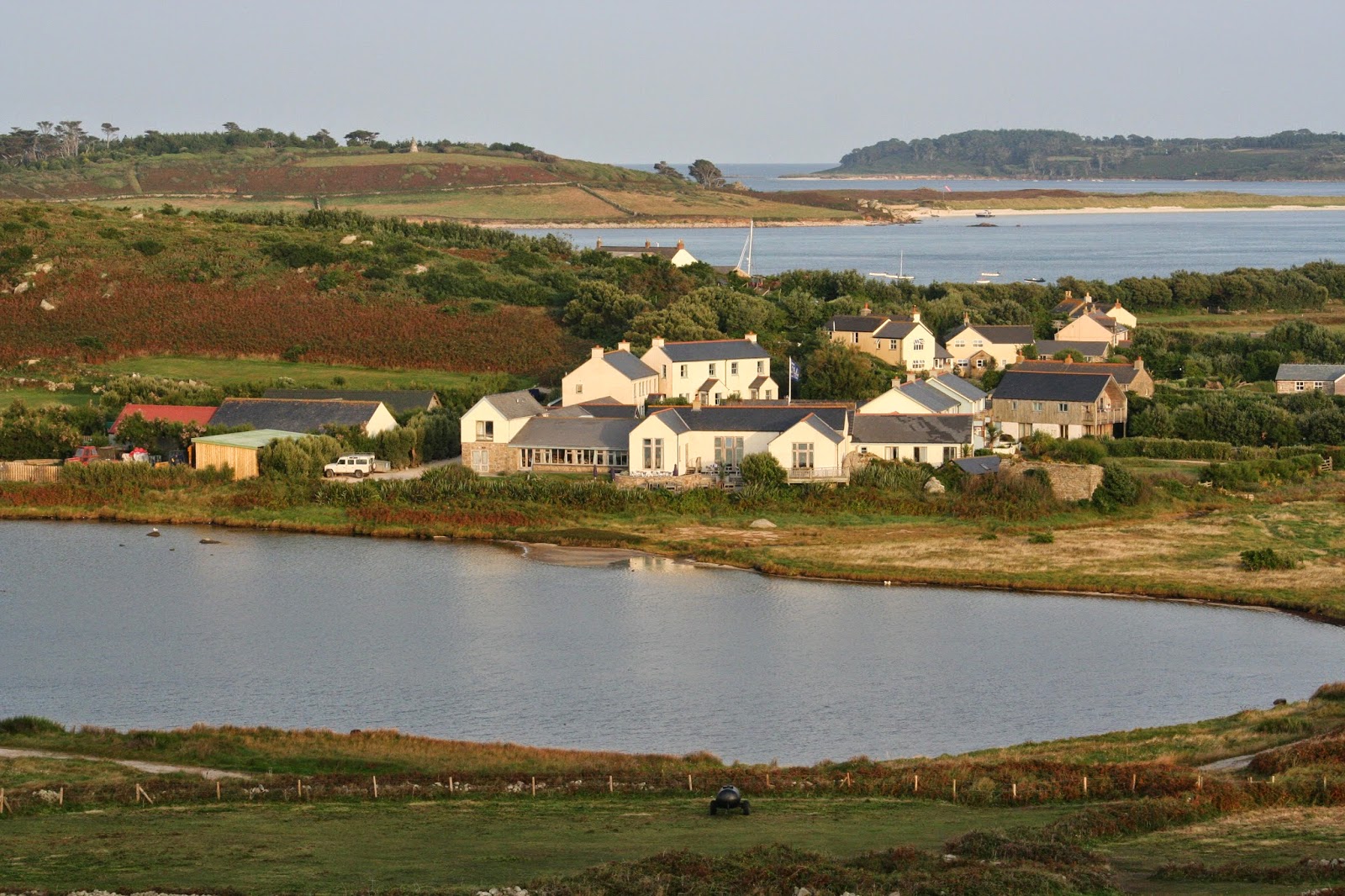
It's been a while since I posted anything on here. Largely due to me being away from all forms of telecommunication on the stunning Isles of Scilly. If you haven't been, I strongly recommend it. For the last eight years I have been lucky enough to travel out there on 'business' each autumn for a week. The RSPB does a series of guided walks on Tresco each September, and I'm part of the squad that is hand-picked to provide members of the public with a unique and unforgettable insight to wildlife around the archipelago. Or so I hope!

Bryher and Tresco
A couple of years ago, the Isles of Scilly Seabird Project began. The aim of this work was to remove rats from St Agnes and Gugh. These islands (actually one island at low tide!) contain large numbers of breeding seabirds, including manx shearwater. Although manxies have been recorded on the islands each year, no chicks have fledged in living memory, because of the impact of the rats on eggs and chicks. So the removal of rats is critical to the survival of the species on these islands.

The 'Bar' connecting St Agnes and Gugh
Last winter, experts from New Zealand were flown in to begin the eradication, assisted by a merry band of volunteers. They began baiting rats and monitoring the population, and by Christmas there were no more signs of rats. This summer, more volunteers have been monitoring the shearwater burrows, and finally ten chicks have been recorded at about fledging age. Instant success!
Manx Shearwater
This is the story I get to tell visitors to the islands. Working in conservation can be quite depressing, with stories of declines, and recoveries taking a very long time. Here we have a fantastic example of what can be achieved when people work together. I get to natter with members of the public about this and other conservation issues, pointing out a few birds and other wildlife along the way, based at the beautiful Abbey Gardens on Tresco. And after eight years on the team, we've got the trip planning sussed.

Tresco Abbey Gardens
The best way to reach the islands, for me, is the Scillonion ferry. It can be a little choppy, and some people are not good on boats, as evidenced on both trips this year (both flat!) when one ill passenger managed to be sick overboard on the top deck, coating many of their fellow passengers on the deck below! But it's a great chance to spot wildlife, with seabirds, seals, sunfish, dolphins and whales all on the potential menu.

Common Dolphin
The boat docks at St Mary's, the largest of the islands, from where you can access the other 'off islands' by inter-island boat. Four other islands are inhabited: St Agnes, St Martins, Tresco and Bryher. Each has a different feel and atmosphere. St Agnes is isolated, St Martin's has picturesque wide sandy beaches, Tresco is manicured, and Bryher is wild and rugged. It is to Bryher that we head first, armed with camping gear. Bryher is our base for the week, despite working on Tresco. This means we have the best commute in the world, setting off from our home on the camp site, down to the quay to get the school boat across to Tresco, then walking up past the shop to pick up large quantities of bread and cheese for lunch, along the great pool and into the hides spotting rare birds, before passing the Abbey and on to our working base at the Abbey Gardens.

Rugged Bryher
Before we get to work we may have seen Lapland bunting, ortolan bunting, spotted crake, little stint, green sandpiper, curlew sandpiper, spotted redshank, spotted flycatcher, whinchat, redstart, and wryneck. Look them up! The wryneck is something that I see every year on the islands, and don't see anywhere else. It's a migrant woodpecker, and has a bizarre habit of twisting it's neck around and flicking it's tongue out. It does this when it feels threatened, to mimic a snake and ward off predators. The Latin name for this species is Jynx torquilla. The 'torquilla' part means 'little twister' in respect to this behaviour. The Jynx part originates in Greek mythology. Iynx was a Greek goddess who used a wyneck love-charm to make Zeus fall in love with Io. When Hera, Zeus' official consort, found out, she transformed Iynx into a wryneck as punishment. This is where we get the word 'Jinx' from - a curse or spell cast.

Lapland Bunting
Even from our base we can now see red squirrels, stick insects, and golden pheasants - all introduced to the island by man, just as the rats made it there by ship and shipwreck. We spend the day doing guided walks, turning round one every hour, and I can hear myself saying the same thing over and over again. Then it's back across the island for the last boat back to Bryher, a spot more birding and then a camp meal together. Having spent all day on our feet and smiling like a synchronised swimmer it's time to cook up a feast from fresh veg and whatever goodies we brought in the food hamper. Huge piles of pasta, curry and chilli adorn our plates each evening, all cooked al fresco over a small stove while watching the sun set over the Atlantic. And then to the pub.

Golden Pheasant
The Fraggle Rock Bar on Bryher is where we spend our evenings, indulging in a pint or two of local ale and running through the day's sightings, chatting with residents and tourists alike, and partaking of the odd game of bananagrams or a geeky bird-related quiz. It also does a killer fish and chips. Many a fine evening has been had here: a perfect end to a busy and tiring day, before staggering back to the camp site under the immense beauty of the milky way, and crawling back into the tent and passing out.

2014 Team!
In Groundhog Day style, we do this all over again, on repeat, for the full week, before final packing up our bags and returning to the mainland. It's quite a shock going back into the 'real' world from somewhere where the time of the tide is the most important time, where emails, internet and news are inaccessible, and where you can forget about all your cares, worries and responsibilities. If you ever need a true break from the busy world, this is the place.

Scilly Sunset


Saturday, 26 July 2014

Eurotrip Day 4

Day 4: The Hangover Tour

Day 4 started earlier than it needed to. In part due to Day 3 encroaching several hours into the early morning, but also because of an early breakfast call from mum, which was ignored in favour of slumber. However, there was a pre-arranged lunch to attend and I needed to retrieve my camera bag that Fran and Graham had kindly taken on when I headed for the club. I agreed to pick it up from their room without realising the problem this would cause. The automatic room key Schindler's lift scenario is highly clever when going to your own floor, but makes getting to another floor virtually impossible. Only the communal floors are findable using the traditional, tried and tested method of pressing a button. Although I tried pressing floor 6, the lift refused to take me there. It did, however, go to another floor, where a couple of other people had summoned it. I then had to travel to where they needed to go before deciding whether to try again or hope that in the fullness of time someone from floor 6 would summon the lift. I opted for the stairs, and made my way up four flights to find that key card access was needed to get into the floor as well! So now I was stranded in the stairwell, only able to escape via my own floor or the lobby. None of this was satisfactory to my throbbing head, so I gave up.

Lunch was an equally testing affair for my head, but nibbling at some salad and necking vast quantities of water improved the situation considerably, and I was soon ready for the afternoon walking tour of Sofia. The tours take you around some of the main attractions of the city centre, with the guide explaining their cultural, historical and religious significance. First we saw a the church of St Nedelya, where the worst Bulgarian terrorist atrocity was carried in 1925. The king was due to be present but escaped unharmed because he was late.

St Nedelya Church

We then saw a statue that had been erected in honour of St Sophia, who was, apparently, nothing to do with the city of Sofia. In fact the statue had offended local clergy as the good lady was adorned with pagan symbols. Worse still, it seemed to have been modelled on this year's Eurovision winner, Conchita.

Saint Sofia or Conchita Wurst?

A lot of the buildings had the square boldness of Communism stamped across them, including the National Theatre, the government buildings and even some of the old churches were dwarfed by the new buildings that had risen around them.


The tour also showed us a slice of Bulgarian life: the people enjoying a Sunday afternoon in the sun, eating ice creams in the parks, relaxing or playing music and games. And in some cases taking a much needed siesta.


Finally we saw the market, with it's bright stalls selling vibrantly coloured scarves and Russian dolls sat incongruously among tables of antique cameras and assorted large knives.


The Bulgarians seem to like their statues and fountains, and sometimes both. There was a water fountain that would have been more at home at a water park, a naked lady dancing in a fountain in front of the theatre, and these grumbling men, all of whom appeared to be in various stages of distress.


Most importantly, there was this shrub in the road.


The walking, the heat, the hangover and the lack of sleep conspired against me by this point, so I grabbed a club sandwich and an ice cream and hit the hotel pool and sauna (the ice cream and club sandwich were gone by this point). A thoroughly relaxing way to end the weekend.